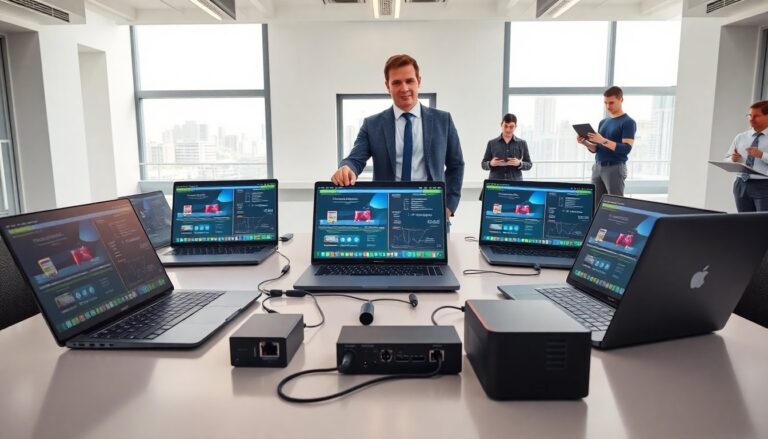

TheLaptopAdviser gaming laptops professionals find clear value in fast, portable hardware. The article lists practical choices and exact priorities for 2026. It explains why professionals pick gaming laptops. It sets clear buying criteria and maintenance steps.
Key Takeaways
- Professionals choose gaming laptops for their powerful CPUs, high-end GPUs, and advanced cooling that support demanding tasks like editing and 3D work.
- TheLaptopAdviser gaming laptops professionals recommend prioritizing a balanced CPU and GPU pairing, with at least 32 GB RAM and NVMe SSD storage for optimal performance.
- Display quality with 100–240 Hz refresh rates and color accuracy, along with reliable thermal management, are critical factors in selecting a gaming laptop for professional use.
- Portability, battery life ranging from 3 to 8 hours, and durable build quality must be balanced based on travel needs and workload intensity.
- A thorough buying checklist includes verifying hardware compatibility, display specs, port availability, cooling efficiency, and warranty service options.
- Regular software updates, thermal maintenance, and use of vendor tools help sustain performance and extend the lifespan of gaming laptops for professionals.
Why Professionals Are Choosing Gaming Laptops Today
Companies and freelancers choose gaming laptops for raw power. Gaming laptops provide strong CPUs and high-end GPUs that accelerate editing, 3D work, and data tasks. They offer higher-refresh displays that help designers and analysts see motion and detail. They also include advanced cooling that keeps performance steady under load. Many models give extensive port options that professionals need for docks and external devices. They trade some battery life for sustained performance. They often cost less per performance point than workstation laptops. TheLaptopAdviser gaming laptops professionals recommend balance price, power, and portability when they select a model.
Key Hardware Specs To Prioritize
Professionals must focus on parts that affect real work speed. The list below highlights the hardware that matters most and why each part affects daily tasks.
CPU, GPU, And Performance Targets
They should pick a CPU with high single-thread and multi-thread performance. Intel Core i7/i9 or AMD Ryzen 7/9 provide clear gains for compiles and renders. They should choose a GPU that matches their software. Nvidia RTX 40- and 50-series and AMD RX 7000-series handle rendering and AI acceleration. They should aim for baseline targets: modern 6- or 8-core CPUs and GPUs with hardware ray tracing for creators who use real-time engines. They should match the CPU and GPU to avoid bottlenecks. TheLaptopAdviser gaming laptops professionals advise checking benchmarks for the actual apps they use.
RAM, Storage, Cooling, And Display Needs
They should install 32 GB of RAM for multitask workflows and 64 GB for large projects. They should use NVMe SSDs for the OS and active projects and larger SSDs or fast external drives for archives. They should prefer dual-drive slots when available. They should select displays that match color and refresh needs: 100–240 Hz for motion work and 100% sRGB or 95% DCI-P3 for color-critical tasks. They should check cooling design: heat pipes, dual fans, and thermal layout matter. They should test thermal throttling in reviews before they buy.
Portability, Battery Life, Build Quality, And Buying Checklist
They must weigh portability against power. Thin gaming laptops offer lighter travel weight but sometimes reduce sustained performance. Thick models deliver better cooling and longer peak speeds. Battery life varies: professionals should expect 3–8 hours under mixed use. Durable chassis with metal or reinforced plastic resist daily wear. Warranty and service options matter for business use. They should confirm repair times and authorized service centers. TheLaptopAdviser gaming laptops professionals recommend balancing weight, battery, and service based on travel frequency.
Buying Checklist And Budgeting Tips For Professionals
They should follow a checklist before they buy. 1) Confirm CPU and GPU match the workload. 2) Confirm at least 32 GB RAM or upgrade path. 3) Confirm NVMe SSD and spare slot. 4) Confirm display specs for color and refresh rate. 5) Confirm ports for docks, Ethernet, and external monitors. 6) Confirm cooling tests in reviews. 7) Confirm service and warranty terms. For budgeting, they should set a 3-year cost view that includes repairs and upgrades. They should compare cost per performance in real workloads rather than headline specs.
Software Optimization, Thermal Management, And Maintenance
They should update drivers and firmware regularly to keep performance stable. They should set power profiles to balance battery and speed. They should use vendor tools for GPU and fan control when available. They should clean air intakes and change thermal paste every 18–30 months if they keep the laptop long-term. They should monitor temps with simple tools and run stress tests after driver updates. They should use external docks and cooling pads when they need sustained high output. TheLaptopAdviser gaming laptops professionals advise a short maintenance routine every three months to extend lifespan and keep peak performance.